
Mythical Ireland
The Tuatha Dé Danann: Gods, Ancestors, or Something Else Entirely?
The Tuatha Dé Danann: Gods, Ancestors, or Something Else Entirely?
Couldn't load pickup availability
THIS LIVE COURSE IS NOW COMPLETELY SOLD OUT
All 40 places on the August–September 2026 course have now been booked.
If you would like to be contacted should a cancellation arise – and receive priority notice when the next live Tuatha Dé Danann course opens for booking – please join the waiting list.
The waiting-list form will appear automatically on this page.
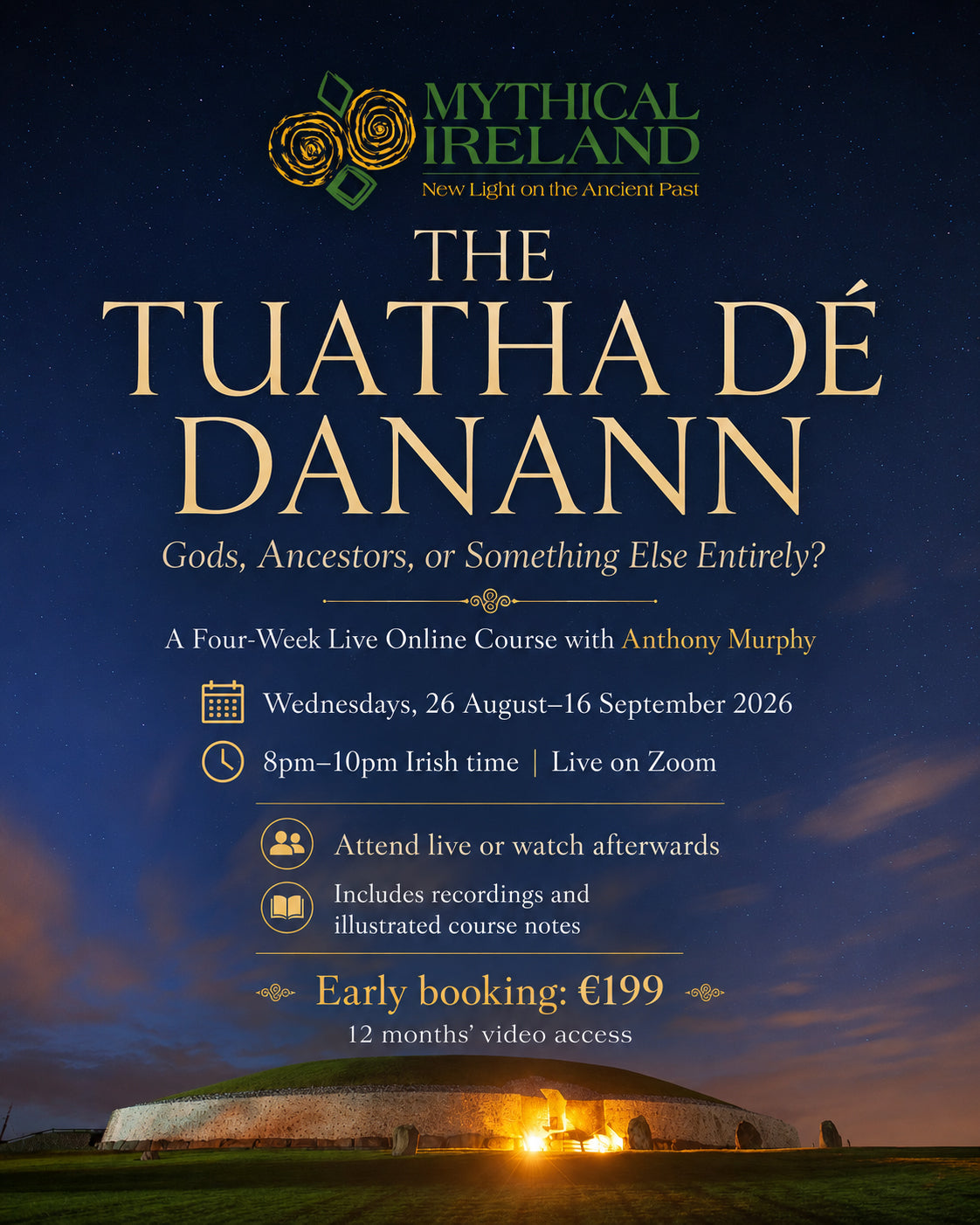
The Tuatha Dé Danann
Gods, Ancestors, or Something Else Entirely?
A four-week live online course with Anthony Murphy of Mythical Ireland
Four Wednesday evenings, beginning 26 August 2026
8pm–10pm Irish time | Live on Zoom
Attend live – or watch every session afterwards at a time that suits you.
Includes illustrated course notes and 12 months’ access to all four class recordings.
Early-booking price: €199 until midnight on Sunday, 9 August
Full price: €229
Who were the Tuatha Dé Danann?
They are the great supernatural race of Irish mythology: warriors, healers, poets, craftspeople, kings, goddesses and shape-shifters.
They possess magical treasures. They fight extraordinary battles. They are associated with some of Ireland’s most ancient monuments and sacred landscapes. After their defeat by the Milesians, they retreat into the síd-mounds and become the mysterious people of the Otherworld.
But who – or what – were they?
Were the Tuatha Dé Danann the gods of pre-Christian Ireland? Were they memories of ancestral peoples? Were they fallen angels, supernatural beings or literary creations?
Or might they be several of these things at once?
Beginning on Wednesday, 26 August, I invite you to join me for a four-week live exploration of one of the greatest and most enduring mysteries in Irish mythology.
Over four substantial two-hour sessions, we will examine the principal stories, personalities, sources and landscapes associated with the Tuatha Dé Danann.
We will encounter the Dagda, Lug, Brigid, the Morrígan, Boann, Nuadu, Manannán, Óengus and many others. We will explore the Battles of Mag Tuired, the four great treasures, the coming of the Milesians, the division of Ireland and the movement of the Tuatha Dé Danann into the hidden world of the sídhe.
Most importantly, we will ask what these stories might have meant, and what may lie beneath the versions preserved by medieval Irish scribes.
This will not be a simple catalogue of “Celtic gods.” Nor will it present modern fantasy or speculation as ancient Irish tradition.
Instead, we will return to the surviving sources, examine their contradictions and complexities, and explore the profound relationship between mythology, sovereignty, sacred landscape and the Otherworld.
You can attend each class live, watch the recordings afterwards or combine both approaches according to your own schedule.
Course at a glance
Dates
-
Wednesday, 26 August 2026
-
Wednesday, 2 September 2026
-
Wednesday, 9 September 2026
-
Wednesday, 16 September 2026
Time
8pm–10pm Irish time each Wednesday
Location
Live online through Zoom.
You can participate from anywhere in the world.
What is included
-
Four live online classes
-
Eight hours of teaching
-
Live questions and discussion
-
Recordings of all four sessions
-
Twelve months’ access to the complete collection of recordings
-
Illustrated PDF course notes
-
Selected source passages and translations
-
Reading and research recommendations
-
No assignments or examinations
Video access
Each class will be recorded and added to a private course area.
Participants will have access to all four recordings until 16 September 2027.
This means you can attend live, catch up on a missed session or watch the entire course afterwards at your own pace.
Places
The live course is limited to 40 participants.
Price
Early-booking price: €199 until midnight on Sunday, 9 August
Full price after 9 August: €229
Current Mythical Ireland patrons and former participants in my online mythology courses will receive a private discount code by email or through Patreon.
What you will discover
By the end of the four weeks, you will have a much deeper understanding of:
-
who the Tuatha Dé Danann are in the surviving Irish texts;
-
why describing them simply as “Irish gods” does not tell the whole story;
-
the principal personalities and relationships within the Tuatha Dé Danann;
-
the meaning and possible origins of their name;
-
the medieval manuscripts through which their stories have survived;
-
the First and Second Battles of Mag Tuired;
-
the Fomorians and their complicated relationship with the Tuatha Dé Danann;
-
the four great treasures brought from the mysterious northern cities;
-
divine kingship, sovereignty, generosity, prophecy and sacred knowledge;
-
the connection between the Tuatha Dé Danann and Ireland’s ancient monuments;
-
the meaning of the síd and the Irish Otherworld;
-
how powerful supernatural beings became the people of the fairy mounds;
-
the difference between early Irish tradition and much later interpretation;
-
why the Tuatha Dé Danann continue to fascinate readers, writers and artists today.
The four-week programme
Week One
Who Were the Tuatha Dé Danann?
We begin with the central mystery.
What does the name Tuatha Dé Danann actually mean? Who was Danu, or was there ever a goddess called Danu in the surviving Irish tradition?
We will examine the principal medieval sources, including Lebor Gabála Érenn, and consider how Christian scholars attempted to incorporate Ireland’s pre-Christian traditions into a biblical history of the world.
We will explore the arrival of the Tuatha Dé Danann in Ireland, the mysterious northern cities from which they supposedly came and the four great treasures they carried with them:
-
the Stone of Fál;
-
the spear of Lug;
-
the sword of Nuadu;
-
the cauldron of the Dagda.
We will also examine the First Battle of Mag Tuired and the loss of Nuadu’s arm – a wound that raises important questions about kingship, bodily perfection and sovereignty.
Among the questions considered in Week One:
-
Were the Tuatha Dé Danann understood as gods?
-
Why did medieval writers portray supernatural beings as ancient kings and warriors?
-
How old might some elements of these stories be?
-
What can – and cannot – be recovered from beneath the medieval texts?
-
Did the Tuatha Dé Danann arrive through the air, in ships or in clouds of darkness?
-
What do the four treasures tell us about power, authority and society?
By the end of the first evening, you will understand why there is no simple answer to the question: “Who were the Tuatha Dé Danann?”
Week Two
The Great Figures of the Tuatha Dé Danann
The second session introduces the most important figures associated with the Tuatha Dé Danann.
We will meet the Dagda, the immensely powerful figure of knowledge, abundance, fertility and kingship; Lug, the master of every art; Nuadu of the Silver Hand; Brigid, associated with poetry, healing and craft; and the Morrígan, the formidable figure of prophecy, battle, sovereignty and transformation.
We will also explore:
-
Boann and the creation of the River Boyne;
-
Óengus and his connection with Newgrange;
-
Manannán mac Lir and the sea-bound Otherworld;
-
Ogma and the power of eloquence;
-
Dian Cécht, Miach and Airmed;
-
Goibniu, Luchta and Credne, the great craftspeople of the Tuatha Dé Danann;
-
Ériu, Banba and Fódla, the sovereignty figures associated with Ireland itself.
Rather than reducing each figure to a single function – “god of war,” “goddess of love” or “god of the sun” – we will examine how complex and contradictory these personalities can be.
Among the stories explored will be:
-
Lug’s arrival at the court of Tara;
-
Nuadu’s silver arm;
-
the healing of Nuadu by Miach;
-
the jealous rage of Dian Cécht;
-
the Dagda’s extraordinary cauldron and club;
-
Brigid’s lament for her son;
-
Boann’s encounter with the Well of Segais;
-
Óengus and the winning of the great síd-mound at Newgrange;
-
the Dagda’s meeting with the Morrígan before battle.
This session will demonstrate why the figures of the Tuatha Dé Danann do not fit neatly into modern categories.
Week Three
The Battle for Ireland
At the centre of the course is one of the greatest surviving narratives in Irish mythology: the Second Battle of Mag Tuired.
The Tuatha Dé Danann have gained Ireland, but their society has fallen under the oppressive rule of Bres.
Although beautiful in appearance, Bres proves to be a defective king. He lacks generosity, fails to uphold the obligations of sovereignty and allows the Tuatha Dé Danann to be subjected to humiliating tribute.
Against this background, Lug arrives at Tara.
He is challenged at the gate and asked what skill he possesses. Warrior, poet, harpist, healer, smith, craftsman and champion – Lug can fulfil every role.
He is Samildánach: the master of many arts.
We will follow the preparations for battle and explore the contributions of the warriors, healers, smiths, poets, magicians and craftspeople.
We will meet Balor of the Evil Eye and examine Lug’s confrontation with his formidable grandfather. We will consider the role of the Morrígan, the death of Nuadu and the restoration of rightful order.
But the Second Battle of Mag Tuired is much more than a fantasy story about two supernatural armies.
It is also a profound meditation on:
-
good and bad kingship;
-
generosity and social obligation;
-
the proper functioning of a community;
-
fertility and the survival of the land;
-
conflict between generations;
-
the relationship between order and chaos;
-
the contribution of every craft and ability;
-
the dangers of withholding knowledge and resources.
We will also ask who the Fomorians really are, and whether they are truly the simple enemies or opposites of the Tuatha Dé Danann.
Week Four
Into the Sídhe
In the final session, another people come to Ireland: the sons of Míl, or Milesians.
We will explore their arrival, the role of the poet Amergin and their encounters with the three sovereignty figures Ériu, Banba and Fódla.
The Milesians ultimately take possession of the visible surface of Ireland. The Tuatha Dé Danann enter another realm: the hills, mounds, lakes and hidden places of the landscape.
This is the world of the síd.
We will examine the meaning of the word síd, the division of the great mounds and the close connections between the Tuatha Dé Danann and some of Ireland’s most important ancient monuments.
Particular attention will be given to Newgrange – known in medieval tradition as Síd in Broga – and the stories of the Dagda, Boann, Elcmar and Óengus.
We will also consider:
-
the division of Ireland between the Tuatha Dé Danann and the Milesians;
-
the difference between the Otherworld and an afterlife;
-
Otherworld time;
-
the Feast of Goibniu;
-
the transformation of the Tuatha Dé Danann into the people of the fairy mounds;
-
encounters between mortals and inhabitants of the síd;
-
the survival of these traditions in folklore;
-
modern literature, art and spirituality;
-
the difference between historical tradition and modern reconstruction.
At the conclusion of the course, we will return to our opening question.
Were the Tuatha Dé Danann gods? Ancestors? Fallen divinities? Literary creations? Memories of an older pantheon? Supernatural inhabitants of the Irish landscape?
Perhaps their enduring power lies in the fact that they cannot be confined to any one of these categories.
Attend live – or learn at your own pace
This is a live, interactive course, but you do not have to attend every session in real time.
All four classes will be recorded and made available to enrolled participants through a private course area.
You may:
-
attend all four sessions live;
-
attend some sessions and watch others afterwards;
-
revisit sections that you found particularly interesting;
-
pause and replay detailed explanations;
-
watch the entire course afterwards at times that suit your schedule.
Access to the complete collection of recordings will remain available until 16 September 2027.
Live attendance gives you the additional opportunity to ask questions and participate in the discussion, but missing a class will not mean missing the material.
This course is for you if…
You are fascinated by Irish mythology but sometimes find its many names, versions and relationships difficult to navigate.
You have read stories about the Tuatha Dé Danann and would like to understand the original sources behind them.
You want to move beyond simplistic lists of “Celtic gods” and discover the richness and complexity of the Irish material.
You are interested in archaeology, ancient monuments and the relationship between story and landscape.
You are a writer, artist, musician, storyteller, guide or educator seeking reliable inspiration and context.
You are part of the Irish diaspora and would like to deepen your connection with Ireland’s mythological traditions.
You previously attended my Introduction to Ireland’s Myths and Legends course and would now like to explore one of its most important subjects in much greater depth.
You are completely new to Irish mythology and want a clear, welcoming and engaging introduction.
No previous academic knowledge is required.
More than a series of lectures
This course will be carefully researched and clearly structured, but I do not want it to feel like a stiff academic lecture.
My approach is conversational and exploratory.
I will explain the sources, tell the stories, draw attention to important details and share my own observations from more than 25 years spent studying Irish mythology, archaeology and sacred landscape.
There will be room for questions, discussion and the unexpected connections that often arise during a live class.
I will distinguish clearly between:
-
what the early texts actually say;
-
how scholars have interpreted them;
-
what can reasonably be inferred;
-
what remains mysterious or uncertain;
-
and what belongs to much later modern interpretation.
You will not be expected to memorise complicated genealogies or sit an examination.
The purpose is to help you see the Tuatha Dé Danann with greater clarity, depth and wonder.
Illustrated course notes
Participants will receive specially prepared illustrated PDF notes to accompany the course.
These notes will contain:
-
summaries of the principal stories;
-
profiles of major figures;
-
names and terminology;
-
important quotations and source passages;
-
maps, images and landscape connections;
-
the main themes from each week;
-
recommended books, translations and further reading.
The notes will allow you to concentrate on listening and participating during the live sessions without feeling that you must write down every detail.
The PDF notes will remain yours permanently.
About your host
Anthony Murphy
I am an author, photographer, broadcaster, tour guide and the founder of Mythical Ireland.
For the past 27 years, I have been exploring Ireland’s ancient monuments, myths and sacred landscapes.
I have written ten books and presented hundreds of episodes of Live Irish Myths, discussing Irish mythology, archaeology, folklore, astronomy and the enduring relationship between story and place. My eleventh book, Ireland: Land of Legend, is being published by Red Stripe Press in October 2026.
My work has focused particularly on Brú na Bóinne, Newgrange and the Boyne Valley – a landscape deeply connected with figures such as the Dagda, Boann and Óengus.
I believe Ireland’s myths deserve to be treated seriously, but never lifelessly.
They are not merely relics from old manuscripts. They remain powerful ways of thinking about landscape, memory, identity, time, creativity and the unseen world.
In this course, I hope to bring together careful research, compelling storytelling and the sense of wonder that first drew me towards the Tuatha Dé Danann many years ago.
What previous Mythical Ireland course participants have said
“His expert knowledge and natural charisma shone through all day.”
— Arnold Hensman
“Scholarly but not stuffy.”
— Paul Hurley
“Anthony’s level of knowledge combined with his passion is astounding.”
— Rucksack Foodie
Excerpts from verified Google reviews of previous Mythical Ireland courses.
Frequently asked questions
Do I need any previous knowledge of Irish mythology?
No.
The course is suitable for complete newcomers as well as participants who already have a good knowledge of Irish mythology.
Important names, sources and concepts will be introduced and explained clearly.
What happens if I cannot attend every live session?
All four classes will be recorded and added to a private course area.
You will have access to the complete collection of recordings until 16 September 2027.
You can therefore attend every session live, watch the entire course afterwards or combine live participation and replay viewing according to your own schedule.
When will each recording become available?
I will aim to make each class recording available within 24 to 48 hours of the live session.
Participants will receive an email when the recording has been added to the private course area.
How long will I have access to the recordings?
Access will remain available for 12 months after the final live class, until 16 September 2027.
The recordings are streamed through a private course area and are not supplied as downloadable video files.
Can I watch the recordings more than once?
Yes.
You can revisit the classes as often as you wish during the 12-month access period.
This may be particularly useful when returning to detailed stories, names, source passages or relationships between different figures.
Will I receive course notes?
Yes.
Illustrated PDF notes will be supplied to registered participants.
The PDF notes will remain yours permanently.
Can I join from outside Ireland?
Yes.
The course is completely online and participants can join from anywhere with a suitable internet connection.
The live sessions begin at 8pm in Ireland.
During the course dates, this corresponds to:
-
8pm in the United Kingdom;
-
9pm in Central Europe;
-
3pm US Eastern time;
-
12 noon US Pacific time.
Please check the equivalent time in your own location before booking.
The recordings also make the course accessible to participants for whom the live session time is inconvenient.
Do I need a Zoom account?
You can normally join a Zoom meeting through the supplied link.
Installing the Zoom application beforehand is recommended for the best experience.
Do I have to appear on camera?
No.
You may leave your camera switched off.
Participants can submit questions through the Zoom chat. There may also be opportunities to ask questions directly, but nobody will be required to speak.
Will participants appear in the recordings?
The recordings will concentrate on the presentation, the shared slides and the principal teaching content.
Participants will be informed that each session is being recorded.
Private or personal discussion may be removed from the published recording where appropriate.
Can two people attend using one booking?
Each booking is for one participant.
Two members of the same household may watch together on one screen. Separate bookings are required for participants joining from different households or devices.
Can I share my video access with someone else?
No.
Course access is for the registered participant or household only and should not be shared with other people.
Unauthorised copying, downloading, recording or redistribution of the videos and course materials is not permitted.
Will there be assignments?
No.
There are no assignments, assessments or examinations.
Suggested readings may be provided for anyone who would like to explore the subject in greater depth.
Is the course suitable for academic researchers?
The course is designed for a broad general audience rather than as an accredited academic programme.
However, it will engage seriously with early Irish texts, translations, scholarship and questions of interpretation.
Researchers, writers, guides and educators should find substantial material of interest.
How will I receive the Zoom links?
Booking confirmation and initial course information will be sent to the email address used during checkout.
Zoom links and reminders will also be sent by email before each session.
Please check your spam, junk or promotions folders if you do not see them.
Reserve your place
The Tuatha Dé Danann have survived centuries of retelling, reinterpretation and transformation.
They have been remembered as gods, kings, warriors, magicians, fairies and ancient inhabitants of Ireland.
Their names remain attached to rivers, hills, monuments and some of the most powerful stories in the Irish tradition.
Over four Wednesday evenings, we will journey from their mysterious arrival in Ireland to the Battles of Mag Tuired, the court of Tara, the great monuments of the Boyne Valley and the hidden world of the sídhe.
Attend live, take part in the discussion and ask questions, or watch the complete course afterwards at your own pace.
I hope you will join me.
The Tuatha Dé Danann
Gods, Ancestors, or Something Else Entirely?
Wednesdays, 26 August–16 September 2026
8pm–10pm Irish time
Live on Zoom
Includes:
-
four live classes;
-
eight hours of teaching;
-
illustrated PDF course notes;
-
recordings of all four sessions;
-
12 months’ video access;
-
live questions and discussion.
Early-booking price: €199 until midnight on Sunday, 9 August
Full price: €229
Limited to 40 live participants.
Cancellations and refunds
A 14-day cancellation period applies where provided by law. Mythical Ireland also normally offers a full refund for cancellations received at least seven days before the first live class. Different terms apply once the course or digital access has begun. Please read our full Cancellation and Refund Policy before booking. Nothing in the policy affects your statutory consumer rights.
Subscribe to our emails
Subscribe to our mailing list for insider news, product launches, and more.